

TiN — the gold-finish general-purpose PVD coating.
TiN is the original commercial PVD coating and remains the industry general-purpose choice — 2–10× tool life on cutting and drilling, and the standard for medical instruments where a bright, biocompatible surface matters.
What TiN is, in numbers.
Approximate properties — final spec is confirmed for every job during quote.
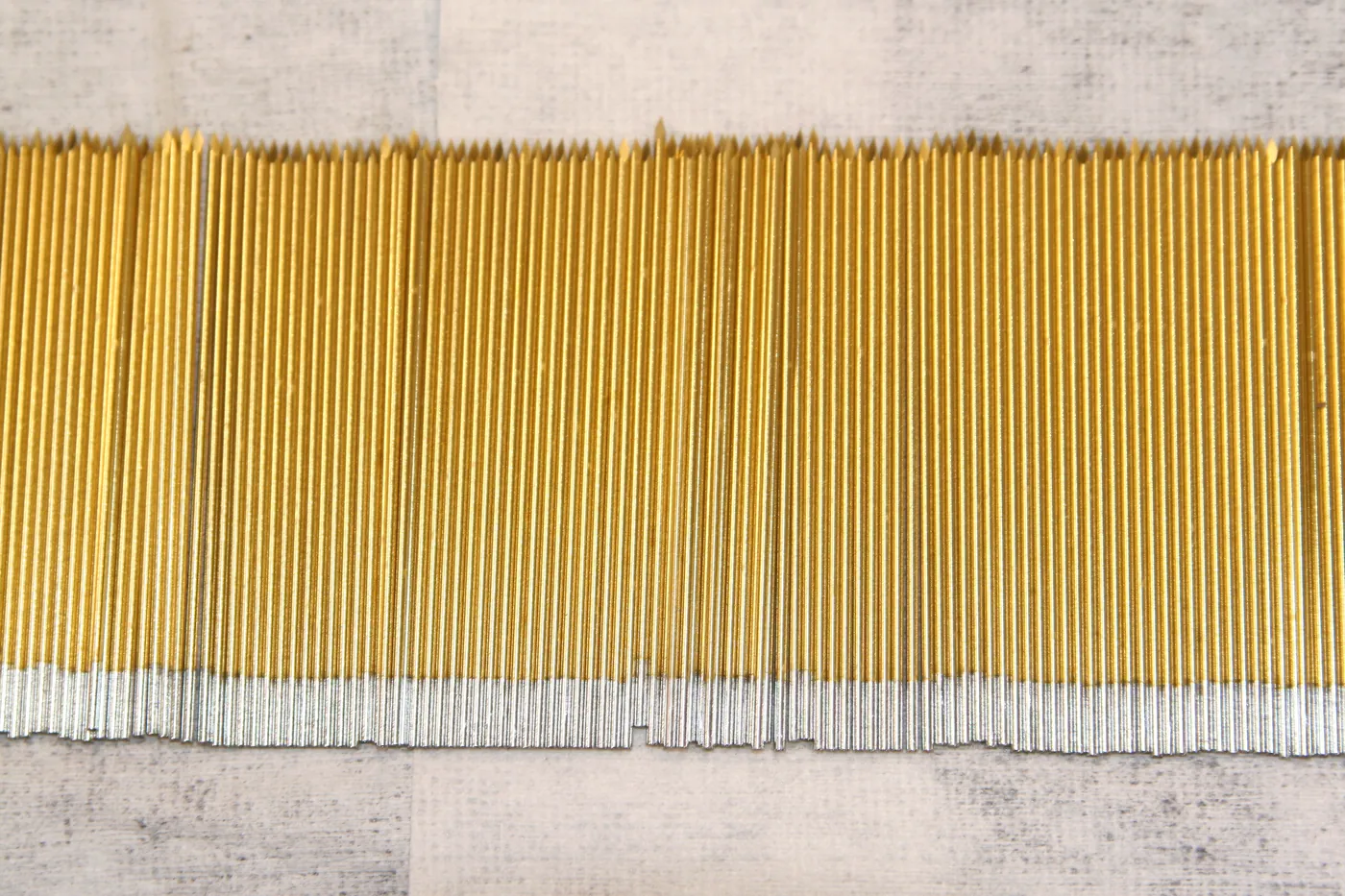
TiN-coated medical needles from a production lot. Gold finish, biocompatible, and the medical-instrument standard.
The coating that made PVD an industry.
Titanium Nitride was the first PVD coating to see widespread commercial use, and it's still the yardstick every other coating is measured against. It's noticeably harder than uncoated tool steel, chemically inert for medical use, and unmistakable on the shelf — a bright gold color you can identify at a glance.
TiN is our recommendation when you want a reliable, well-understood coating for cutting tools, drills, taps, and general tooling — and it's the coating we apply to most medical instruments. If you're new to PVD and looking for a place to start, TiN is almost always the right first coating to try.
Need more life than TiN can provide? Talk to us about Alpha, or step up to TiCN for harder coatings and improved wear resistance.
Where TiN shines
- General cutting & drillingReliable performance on carbide and HSS tooling.
- Medical instrumentsBiocompatible and traceable — the industry standard.
- Decorative gold finishBright, durable gold on visible surfaces.
Frequently Asked Questions About Titanium Nitride (TiN) PVD Coating
Straight answers on finish, hardness, thickness, substrates, cost and process.
What does Titanium Nitride (TiN) coating look like?
TiN coating features a distinct, brilliant gold metallic finish that makes wear patterns easily identifiable on tooling, precision machinery, and surgical instruments.
How hard is TiN coating?
TiN provides extreme surface hardness, rated at approximately 2,600 HV (Vickers hardness)—or roughly 80+ HRC equivalent. This significantly outperforms conventional tool steels, industrial chrome plating, and carbide substrates.
How thick is TiN coating?
TiN thin-film coating typically measures 1 to 5 microns (0.00004″ to 0.0002″). This micro-thin profile enhances surface hardness and lubricity without compromising critical component tolerances or thread geometries.
What materials and substrates can be coated with TiN?
TiN bonds effectively to a wide range of industrial substrates, including:
- Steels: High-speed steels (HSS), hardened tool steels, and carbon steels
- Stainless Steels: 300- and 400-series grades
- Carbide & Nickel Alloys: Inconel, cobalt-based alloys, and sintered carbides
Pre-treatment evaluation: Substrates undergo thermal analysis prior to application to ensure substrate heat-treatment temperatures exceed PVD processing temperatures (~425°C to 450°C), preventing core softening or dimensional distortion.
Can you apply TiN coating to aluminum and copper?
Yes, aluminum, copper, and copper-beryllium alloys can be coated using customized, lower-temperature PVD deposition cycles. Due to the specialized vacuum parameters required, these substrates are evaluated on a case-by-case basis according to volume and application specs.
Is a thicker TiN coating better for tool life?
Optimal thickness depends on your operating conditions and tooling geometry:
- Heavy wear and forming tooling: Thicker deposits (3 to 5 microns) dramatically increase service life in metal stamping, punch dies, and high-abrasion forming operations.
- Micro-tooling and razor-edge cutting tools: Thinner deposits (1 to 2 microns) are recommended to maintain micro-edge sharpness, as excess buildup can round the cutting radius and reduce edge efficiency.
Is TiN coating thickness completely uniform across a part?
Because Physical Vapor Deposition (PVD) is a line-of-sight process, coating thickness naturally varies depending on part geometry, chamber fixturing, and vacuum deposition duration:
- Wear surfaces: Parts are rotated and positioned facing the cathode to maximize deposit thickness on critical working faces.
- Sharp edges: Corners and cutting edges attract a slightly denser plasma field, resulting in a naturally thicker deposit than flat planes.
- Fixturing contact points & recesses: Areas shielded by mounting fixtures or deep internal geometries receive thinner deposits or remain uncoated.
Can TiN coating be stripped and recoated from industrial tooling?
Yes, TiN thin-film coatings can be chemically stripped from most standard tool steels and stainless grades without damaging the base substrate.
- Carbide substrate warning: Chemical stripping agents aggressively leach the cobalt binder out of tungsten carbide, compromising substrate integrity. For carbide tooling, mechanical removal (micro-abrasive blasting or precision regrinding) is recommended over chemical stripping.
What is the maximum operating temperature of TiN coating?
TiN maintains thermal stability and high lubricity at working temperatures up to 600°C (1,112°F) before surface oxidation begins, making it suitable for moderate to high-heat metal cutting and forming operations.
How much does TiN coating extend tool life?
On metal cutting and forming tools, TiN typically extends working life by 2x to 7x (200% to 700%) compared to uncoated tooling. Actual tool life gains depend on:
- Cutting parameters (speeds, feeds, and coolant usage)
- Substrate material and edge preparation
- Coating thickness and specific wear application (tapping, stamping, or milling)
How much does TiN coating cost?
TiN coating generally represents only 5% to 10% of the replacement cost of a new tool. Achieving even a 2x increase in tool life yields a rapid return on investment. You can estimate your project savings directly using our ROI Calculator. Final batch pricing is determined by:
- Overall part dimensions and volume per batch
- Ultrasonic cleaning and surface prep requirements
- Custom fixturing, masking, or chamber rack density
How is TiN coating applied to tools?
TiN is deposited using a Cathodic Arc Physical Vapor Deposition (PVD) process inside a high-vacuum chamber:
- Chamber Loading & Rotation: Parts are mounted on rotating carousels positioned directly in the line of sight of high-purity titanium cathodes.
- Arc Evaporation: An electric arc vaporizes the titanium target into a highly ionized metallic vapor.
- Plasma Reaction & Condensation: Nitrogen gas is introduced into the vacuum chamber, reacting with the vaporized titanium to form a micro-thin ceramic film that condenses atom-by-atom onto the substrate.
- Target Deposition: The cycle runs under precise temperature control until the specified micron thickness is achieved.
Compare TiN with the rest of our lineup.
Ready to try TiN on your tools?
Send us the part, material, and application. We respond within one business day.